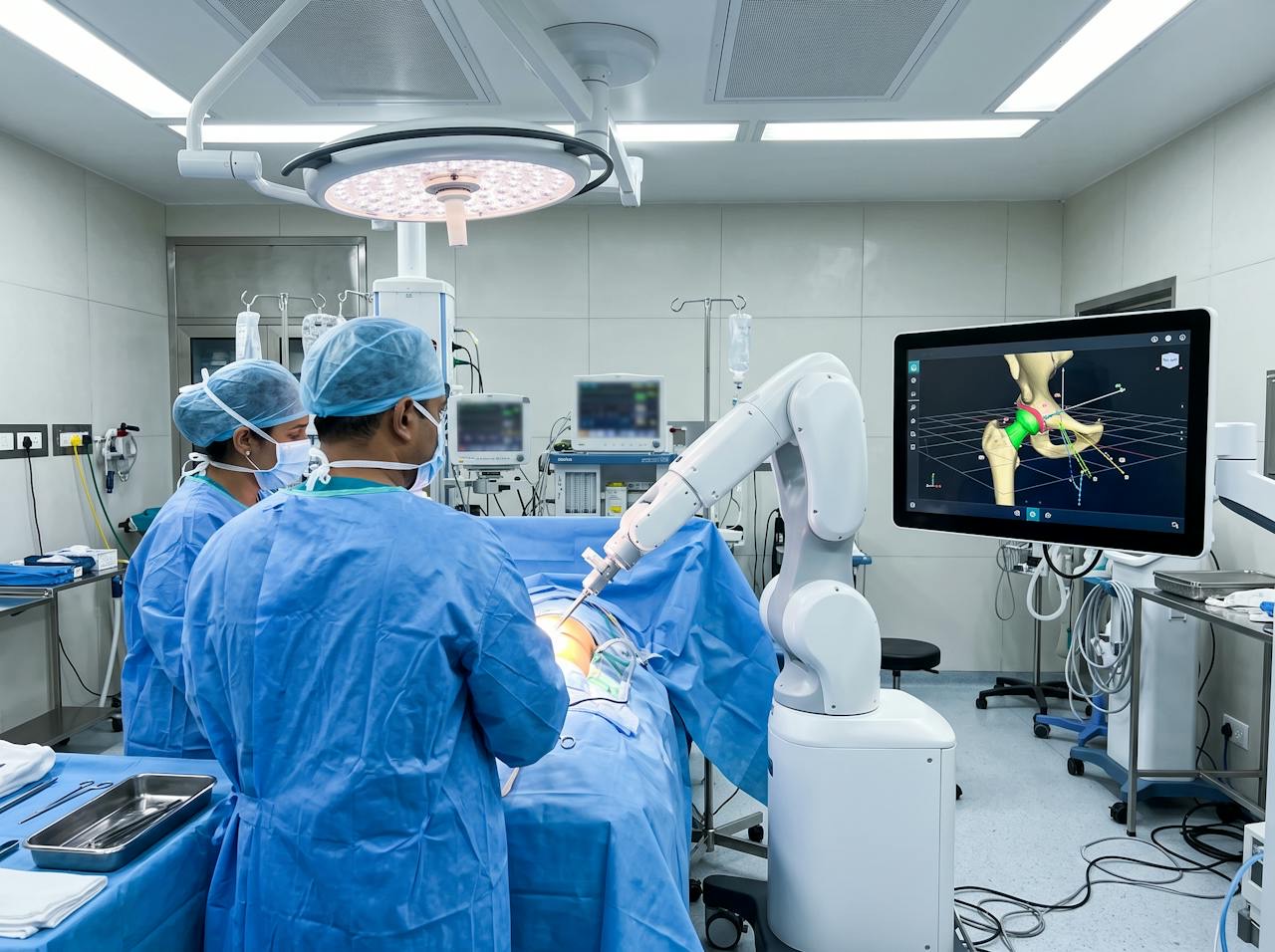


Hip joint replacement in Secunderabad
Hip joint replacement, also called hip arthroplasty, replaces a worn or damaged hip joint with artificial parts. The hip carries your body weight with every step. When it is damaged by arthritis, AVN or injury, the pain can affect walking, sleep, work and independence.
In hip replacement, the worn bone and cartilage are removed and replaced with implants that work like a natural hip: a stem in the thigh bone, a ball, and a socket in the pelvis, made from metal, ceramic and medical-grade plastic. When only the ball of the hip is damaged, as in some fractures, a hip ball replacement (hemiarthroplasty) may be enough.
Dr. Arun Dev performs total hip replacement, hip ball replacement, robotic hip replacement and complex revision hip surgery at Renova Hospital, Kompally, for patients from Secunderabad, Alwal, Bowenpally and across Hyderabad.
When is hip replacement needed?
Hip replacement is most often used to treat:
See a hip specialist if you notice:
- Pain in the groin, thigh or buttock when walking
- Pain at night or when resting
- Stiffness putting on shoes and socks
- A limp or one leg feeling shorter
- Difficulty climbing stairs or getting out of a chair
- Pain that stays despite medicines and physiotherapy
Treatment options for hip pain
Dr. Arun starts with the simplest treatment that can work, and recommends surgery only when it will genuinely help.
The hip replacement procedure
Hip replacement is usually done under spinal or general anaesthesia. The main steps are:
- Incision. A cut is made along the side or back of the hip to reach the joint.
- Removing damaged bone and cartilage. The worn ball of the thigh bone and the damaged socket surface are carefully removed.
- Placing the socket. A new socket is fixed into the pelvis, lined with a smooth bearing surface.
- Placing the stem and ball. A metal stem is placed in the thigh bone and a metal or ceramic ball is fitted on top, then the joint is checked for stability and leg length.
- Closing the wound. The wound is closed with stitches or staples and covered with a sterile dressing.
Benefits of hip replacement
Recovery after hip replacement
Physiotherapy restores strength, flexibility and range of movement, and pain is managed with medicines and cold therapy. Weight-bearing increases step by step under supervision, and most people return to their regular activities within a few months.
- In hospital First steps You stand and walk with a walker under the physiotherapy team’s guidance.
- [First 2 weeks] Walking at home Walking with support, hip precautions and daily exercises.
- [Weeks 3 to 6] Getting stronger Walking improves and support is reduced as the muscles strengthen.
- [Around 3 months] Back to routine Most people return to normal daily activities, with a review by Dr. Arun.
Before you decide
- Implant life. Modern hip implants are strong and long-lasting, though very heavy stress can wear them sooner. Ask Dr. Arun what to expect.
- Other health conditions. Tell Dr. Arun about any medical problems, such as an infection or uncontrolled diabetes, so they can be managed before surgery.
- Rehabilitation matters. Keeping up with physiotherapy and lifestyle changes is key to a good result.