
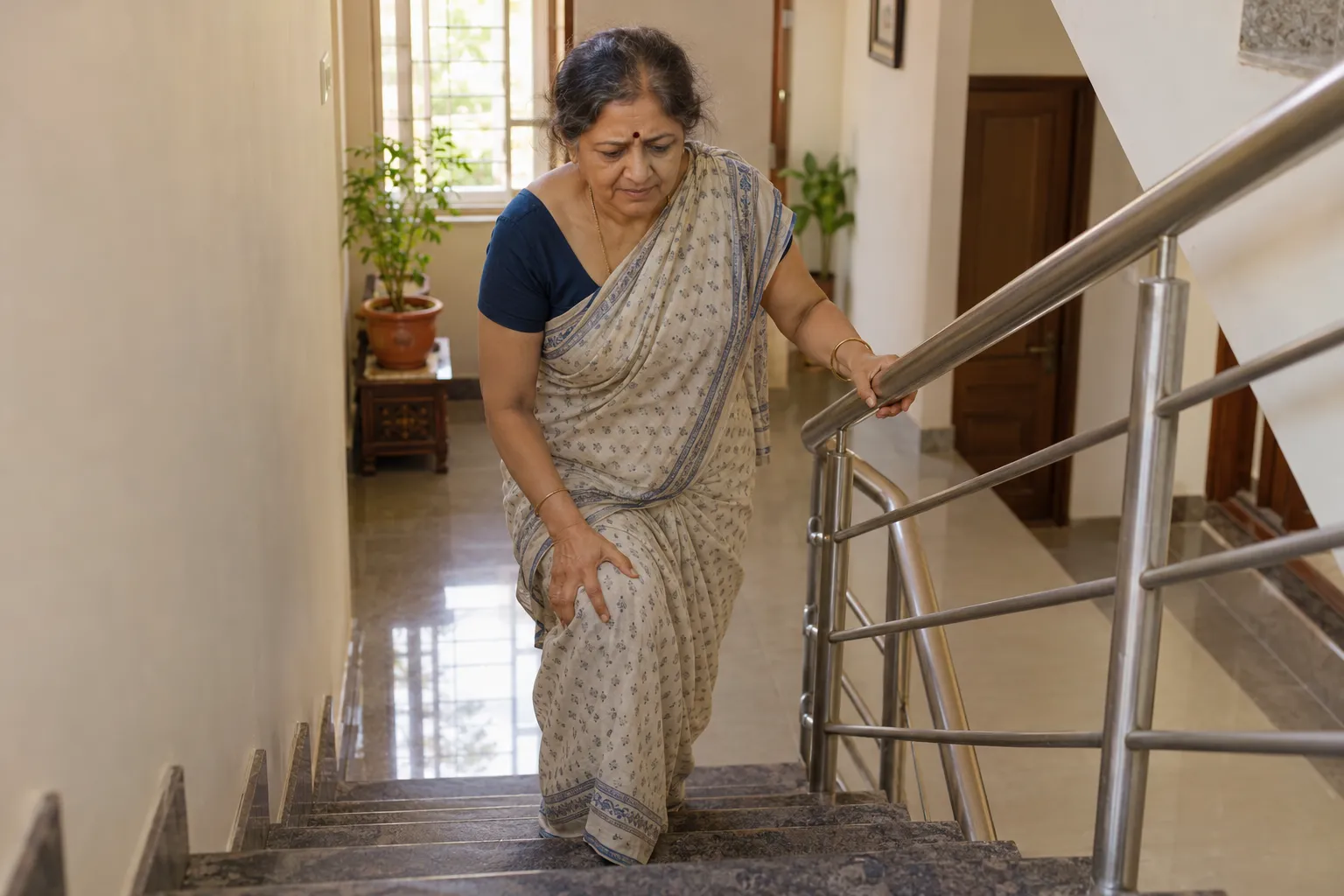
“Doctor, is it time for my knee replacement?” is one of the questions I hear most often in my OPD. Some patients come too early, hoping an operation will end a pain that physiotherapy could still fix. Many more come too late, after years of walking less, sleeping badly and giving up the things they enjoy.
There is no single age or X-ray finding that decides it. The right time is when knee arthritis is damaging your daily life and the simpler treatments have stopped working. This guide explains how to recognise that point, what to try before surgery, and what waiting too long can cost you.
What knee replacement actually does
In knee arthritis, the smooth cartilage that covers the ends of the bones wears away. The bones start to rub, the joint swells, and over time the leg can bend into a bow shape. In a knee replacement, the worn surfaces are removed and covered with metal and a medical-grade plastic spacer, giving the joint a smooth surface again.
When only one part of the knee is worn, a partial knee replacement may be possible. When the whole joint is affected, a total knee replacement is done. At Renova Hospital, Kompally, both can be done with robotic-arm assisted knee replacement, which helps plan the cuts and the implant position for your knee before the operation begins.
Seven signs it may be time to consider knee replacement
You do not need all of these. But if several sound familiar, it is worth a proper assessment.
- Pain wakes you up at night. Pain that disturbs sleep, even when the knee is resting, is a sign the arthritis is advanced.
- You can no longer walk the distance you used to. If a walk to the temple, the market or the park now needs several stops, the knee is limiting your life.
- Stairs have become a daily struggle. Many homes in Secunderabad and Hyderabad have stairs with no lift. If you avoid going up to the terrace or visiting family because of the stairs, take that seriously.
- Your leg is bending. A bow-legged (or, less often, knock-kneed) shape that is getting worse means the joint is wearing unevenly. Severe deformity makes surgery more complex the longer it is left.
- Painkillers are part of every day. Taking pain tablets daily for months is not a safe long-term plan, especially if you have diabetes, high blood pressure, kidney problems or acidity.
- Injections and physiotherapy no longer help. If a few months of proper exercise, weight control and injections have given little or short-lived relief, the joint may be beyond what they can fix.
- The knee is stiff or gives way. A knee that will not straighten fully, or that buckles while walking, raises the risk of falls.
What the X-ray shows, and why it is not the whole answer
A standing X-ray of both knees shows how much joint space is left. When the space has closed completely, doctors describe it as “bone on bone”. Bone spurs, cysts and the angle of the leg are also checked.
But the X-ray is only half of the decision. Two people with the same X-ray can live very different lives. One may walk comfortably with a little help, while the other cannot manage the stairs at home. That is why your symptoms, your daily needs and your general health matter as much as the scan. An MRI is not usually needed to diagnose knee arthritis, though it can help when the cause of pain is unclear.
Treatments to try before surgery
In early and moderate arthritis, most people improve without an operation. A good surgeon will always discuss these options first.
- Strengthening exercises. Strong thigh muscles take load off the knee. A structured physiotherapy programme is the single most useful treatment for early arthritis.
- Weight control. Every extra kilogram adds several kilograms of load on the knee with each step. Even a modest weight loss can ease pain.
- Activity changes. Reducing deep squatting, sitting cross-legged on the floor and using an Indian-style toilet can slow the wear and reduce pain.
- Short courses of medicine. Pain relief tablets or gels, used for short periods under a doctor’s advice.
- Joint injections. Steroid, hyaluronic acid or PRP injections can give relief for some months in selected patients.
- Knee-saving surgery. In younger, active patients with wear on one side and a bent leg, an osteotomy (realigning the bone) can delay or avoid a replacement. Read more on our knee preservation page.
If you have tried these properly, usually for three to six months, and the knee is still controlling your life, it is reasonable to talk about replacement.
“Am I too young or too old?”
Most people who have a knee replacement are between 55 and 80, but age alone does not decide it. A fit 82-year-old can do very well, while a 50-year-old with severe arthritis from an old injury may need it sooner. What matters more is your overall health, how well conditions like diabetes and blood pressure are controlled, and what you want to get back to doing.
Before surgery, we check your heart, blood sugar, kidneys and any infection, including dental and urinary infections. If something needs improving first, such as high blood sugar, we work on it with your physician so that surgery is as safe as possible.
What happens if you wait too long
Waiting is sometimes the right choice. But waiting for years with severe arthritis has costs that patients do not always expect.
- The thigh muscles weaken from walking less, which can slow recovery after surgery.
- The leg deformity can increase, which can make surgery more complex.
- Months of limping often bring pain in the other knee, the hips and the lower back.
- Long-term painkiller use can affect the stomach and kidneys.
- Less activity can lead to weight gain and poorer control of diabetes and blood pressure.
The aim is not to operate early. It is to operate at the right time, before arthritis takes away years of good, active life.
What recovery looks like
Most patients start walking with a walker within a day or two of surgery, with the help of the physiotherapy team. Over the following weeks you move to a stick and then to walking on your own, while exercises restore bending and strength. Many patients are back to daily activities around the home within six weeks and keep improving for several months. Our physiotherapy team guides you through each stage.
Deep squatting and sitting cross-legged on the floor are usually not advised after a knee replacement, and many patients switch to a Western-style toilet at home. Talk to your surgeon about your daily routine, prayers and work so the plan fits your life.
How to choose a knee replacement surgeon in Secunderabad
- Choose a surgeon with specialist training and regular experience in joint replacement.
- Ask whether treatment without surgery has been considered for your knee.
- Check that the hospital has a dedicated operating theatre, intensive care support and physiotherapy on site.
- Make sure you understand the type of implant, the recovery plan and the total cost before you decide.
- Read reviews from patients who have had the same surgery.
Dr. Arun Dev trained in orthopaedics at KEM and Sion Hospitals in Mumbai and completed a joint replacement fellowship at SHALBY Hospitals. He sees patients at Renova Hospital on Medchal Road, Kompally, which is easy to reach from Secunderabad, Alwal, Bowenpally, Suchitra and the rest of north Hyderabad. Learn more about knee replacement with Dr. Arun Dev.
Frequently asked questions
Is there a best age for knee replacement?
No. Most patients are between 55 and 80, but the decision depends on how badly arthritis affects your life and your general health, not on age alone.
Can knee replacement be avoided with exercise?
In early and moderate arthritis, exercise, weight control and injections often control pain for years. In advanced arthritis with severe pain or deformity, exercise helps recovery but cannot replace the worn cartilage.
Should both knees be replaced at the same time?
Some patients with severe arthritis in both knees can have both done together, if they are fit enough. Others do better with the two operations a few weeks or months apart. Your surgeon will advise based on your health.
How long does a knee replacement last?
Modern knee replacements last many years in most patients. Keeping a healthy weight and staying active with low-impact exercise, such as walking and cycling, helps the joint last longer.
Is robotic knee replacement better?
Robotic-arm assistance helps the surgeon plan and place the implant with high precision for your knee. It is one of the options Dr. Arun Dev offers. Whether it suits you is discussed at your consultation.
Book a knee assessment in Kompally, Secunderabad
If knee pain is limiting your walking, your sleep or your stairs, an honest assessment is the first step. Dr. Arun Dev sees patients at Renova Hospital, Medchal Road, Kompally, Monday to Saturday, 9 am to 8 pm. Call or WhatsApp +91 86187 27200 or book an appointment online.
This article is general information and is not a substitute for a consultation. Please see a doctor about your own condition.